
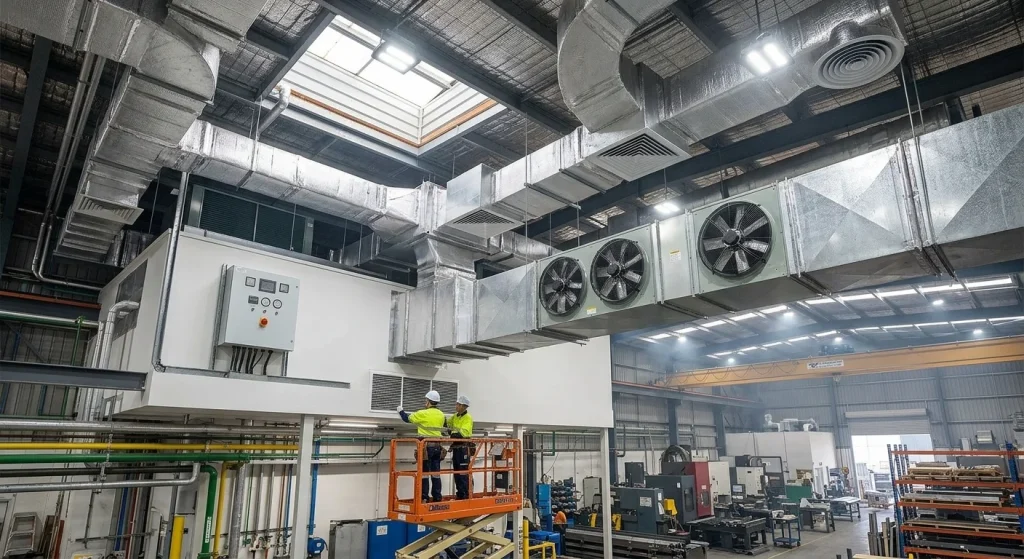
Plan factory HVAC retrofits with Protector Air Care in Melbourne around shutdown windows, access, commissioning and production restart requirements.
Ageing HVAC plant can create reliability risks for factories where cooling, ventilation or refrigeration supports daily operations. Factory HVAC retrofits are easier to manage when equipment changes, shutdown windows, site access and restart requirements are agreed before installation work begins.
How Should Factory HVAC Retrofits Be Planned Around Production?
The retrofit programme should start with the facility’s operating timetable, not only the condition of the equipment. Production runs, cleaning periods, shift changes, planned maintenance stops and temperature-sensitive areas can all affect when mechanical work can proceed.
At Protector Air Care, our commercial and industrial HVAC services include retrofits and equipment upgrades for ageing air-conditioning and refrigeration plant. We also work across chillers, boilers, cooling towers, controls and other mechanical HVAC equipment, allowing the proposed scope to be considered against the existing plant arrangement.
Before equipment is ordered, confirm whether the project can be staged, whether any temporary arrangements are technically suitable and which systems must remain available during each work period. A retrofit may still require complete isolation for part of the changeover, so shutdown requirements should be identified rather than assumed away.
What Site Information Should Be Confirmed Before Work Starts?
A useful site brief gives the project team enough information to plan labour, access and commissioning around the factory’s operating constraints.
Confirm:
- Production timetable: Identify high-output periods, shift changes, cleaning windows and approved shutdown dates.
- Critical areas: Record rooms, processes, products or equipment that depend on controlled temperature, ventilation or refrigeration.
- Existing plant: Provide equipment schedules, service records, controls information and known faults where available.
- Access and lifting: Confirm delivery routes, roof or plant-room access, lifting restrictions and exclusion zones.
- Electrical and controls work: Identify isolations, switchboard interfaces and BMS or control-system changes that could affect the changeover sequence.
- Restart requirements: Agree what must be tested, commissioned and handed back before production resumes.
Our guide to industrial cooling plant upgrades for production uptime explains how ageing cooling equipment can be reviewed before a broader upgrade scope is confirmed.
How Should Installation and Commissioning Be Sequenced?
Factory HVAC retrofits can include staged enabling works such as pipework, supports, controls and electrical preparation before the main shutdown. AIRAH’s commissioning guidance explains that commissioning verifies systems are installed and tested against operational requirements. Testing should therefore be scheduled into the programme rather than left until the end of the shutdown.
Where controls form part of the scope, our BMS and controls upgrade guidance provides more detail on integrating monitoring and control changes with existing HVAC equipment.
Contingency planning should also cover delayed components, inaccessible services, unexpected equipment condition or a failed commissioning check. The restart date should depend on verified system operation, not simply the completion of physical installation.
Move Forward with a Planned Factory HVAC Retrofit
Protector Air Care provides commercial and industrial HVAC, refrigeration and mechanical services across Melbourne and Victoria, including plant retrofits, equipment upgrades and control-system work. Factory HVAC retrofits can be scoped around the existing plant, operational requirements and available shutdown periods without assuming that every project can remain fully operational throughout the work.
Contact us with your factory location, plant details, service history, operating hours and preferred shutdown windows to arrange an assessment and discuss a practical retrofit scope.