
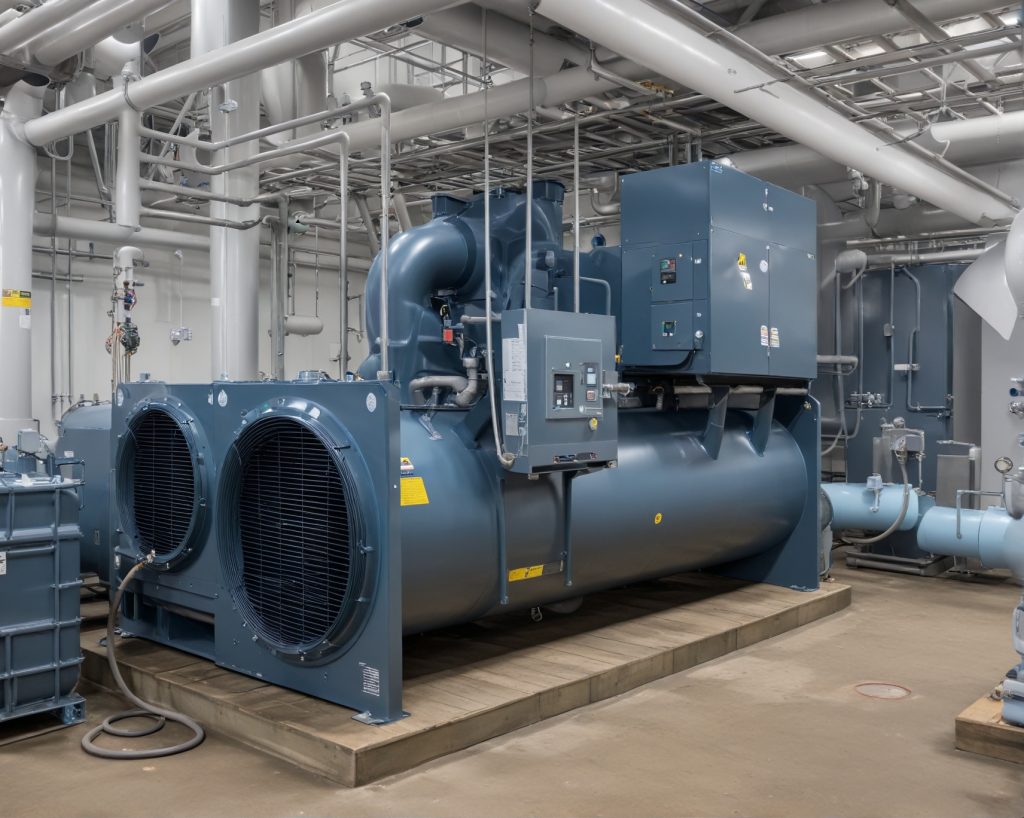
Protect cooling output with chiller performance testing from Protector Air Care, detecting capacity loss before it disrupts Melbourne site operations.
Chiller performance testing measures whether an operating chiller is producing the cooling duty expected for its actual load and conditions. For Melbourne industrial facilities, we use the findings to expose capacity loss before it becomes unstable temperatures, excessive energy use or unplanned downtime.
What Does Chiller Performance Testing Measure in an Industrial System?
A useful test does more than record a single temperature. We assess the chiller and its connected water circuit under a representative operating load, then compare the readings with available design, commissioning, manufacturer and historical information.
Depending on the plant and accessible instrumentation, the assessment may consider:
- Chilled-water supply and return temperatures: The temperature difference helps establish how the water side is responding to the current load.
- Water flow and cooling duty: Flow and temperature data can be used to determine the heat being removed when the measurements are reliable.
- Electrical demand and efficiency: Input power considered against calculated cooling duty can indicate whether performance has drifted.
- Operating pressures, setpoints and controls: Abnormal readings or control behaviour can reveal restrictions, sensor error, staging problems or unsuitable settings.
Our chiller diagnostics and performance testing is part of our commercial HVAC and mechanical services for Melbourne and Victorian facilities.
Which Results Reveal Hidden Chiller Capacity Loss?
Hidden capacity loss means the chiller remains operational but cannot produce the expected duty efficiently at the assessed conditions. The clearest evidence is a repeatable gap between measured and expected performance, supported by related system readings – not one isolated data point.
Warning patterns can include longer run times, unstable chilled-water temperatures, rising power demand at a comparable load, poor heat-exchanger approach temperatures, unexpected compressor loading or incorrect sequencing. These symptoms can also have causes outside the chiller.
The Australian Government’s chiller efficiency guidance notes that chiller efficiency and whole-system optimisation are important to high-performing HVAC operation. Testing turns that principle into site evidence facility managers can use when prioritising maintenance, controls work, cleaning, repair, upgrade or replacement.
When Should Facility Managers Arrange Testing?
Testing is commercially useful when cooling output has become uncertain or a capital decision needs evidence. We commonly recommend an assessment when:
- Unexplained operating-data changes in energy consumption or temperature
- Recurring chiller faults remaining after routine servicing
- Dependence on stable cooling for production, tenants or temperature-sensitive assets
- Consideration of a chiller rebuild, retrofit or replacement
- Baseline performance measurement after major work
Testing does not replace annual chiller maintenance. Used together, maintenance history and measured performance create a stronger basis for deciding whether the next step is calibration, cleaning, controls correction, component work or a larger plant upgrade. Our article on warning signs of commercial chiller failure also helps facility teams distinguish gradual deterioration from an emerging fault.
Use Chiller Performance Testing to Plan the Right Intervention
Chiller performance testing should end with defensible findings, not a vague efficiency promise. We document the observed conditions, explain material variances and identify the next practical investigation or maintenance priority within the agreed scope.
For a low-friction first step, send us the chiller model, site location, recent fault history and the performance problem you are seeing. We can confirm whether a targeted chiller performance assessment is appropriate and outline the information required for a site-specific quote.